Tuesday, November 26, 2013

What Homebuyers Can Be Thankful for in 2013

miniature house in miniature...


Homebuyers have had it tough lately, suddenly finding themselves in a sellers market as summer came along. And mortgages suddenly cost more too -- when you could even get one. But of course Thanksgiving isn't about looking at negatives. So, if you can, look past that elephant-in-the-room that is the credit crunch and take stock of what's now on the table for those homebuyers with the capital.

Low Mortgage Rates: Yes, mortgage rates rose year, along with home prices, but rates are still at historic lows (we are constantly assured) and have been sinking in recent weeks. Can housing prices be far behind? If you are really ready to buy, those Black Friday bargains are small potatoes compared to what you might save by shopping right now in real estate's historically slow season[2] -- especially from sellers who saw summer's homebuying frenzy pass them by.

A Bidding-War Cease-Fire: The heated bidding wars that have been witnessed in some real estate markets -- especially in California -- reportedly have cooled with weather and amid rumors that sellers were deliberately underpricing their homes[4] to encourage competing bids. And although home prices continued to climb[5] as summer drew to a close, it was at a slower pace. Meanwhile, the number of Americans applying for home loans[6] has plunged.

Weary and Wary Investors: Speaking of the competition, the real estate speculators appear headed for the sidelines after years of swooping in to snatch up bargain properties with ready cash. A recent poll of investors[7] found that only around 1 in 5 are still interested in buying more homes -- about half the number from a year ago. For average home-shoppers that means less competition from a preferred class of homebuyers. Meanwhile, those foreign investors who were reportedly buying Florida property sight-unseen[8] at the beginning of 2013 (and even giving Detroit a nibble) might have moved on to Portugal and Spain[9], where 3 million homes lie vacant and the governments are ready to barter with tax incentives and visas.

The 'Nuclear Option': What does the real estate market have to do with the recent change in the U.S. Senate's filibuster rules[10]? It means that Rep. Mel Watt (D-N.C.), the Obama administration's nominee to head the Federal Housing Finance Agency[11] might finally be confirmed. And if that happens -- and it's only a glimmer of a possibility at this point -- Watt might drop plans to lower the ceiling on the amount of money[12] available for government-backed mortgages. Ideological and political conflicts aside, that would be good news right now for homebuyers who might otherwise not be able to afford their dream homes.

The Latest Technology: In many ways technology has made home shopping easier than ever -- much less dependent on guesswork and reliance on third parties -- and it only seems to be getting more convenient. Along with smartphone apps for homebuyers[13] (many of them free) that calculate mortgage payments and estimate home values, there's at least one that instantly accesses information about a home just by taking a snapshot of it with a smartphone camera. Others detect homes with recent price reductions; screen for upcoming open houses; rate neighborhoods on the basis of crime rates[14]; and do the numbers based on "lifestyle"[15] -- such as how much it might cost to commute to work from a new location. So even if you aren't ready or able to buy, some of these apps can aid in a search for a rental.

Source : http://realestate.aol.com/blog/on/reasons-home-buyers-thankful-2013/

US building permits soar to 5-year high in October

Permits for future U.S. home construction rose to their highest level in nearly 5-1/2 years in October, suggesting the housing market recovery remained intact despite recent signs of slowing down.

The Commerce Department said on Tuesday building permits jumped 6.2 percent to a seasonally adjusted annual rate of 1.03 million units. That was the highest rate since June 2008. Permits increased 5.2 percent in September.

August's permits were revised to a 926,000-unit pace from the previously reported 918,000 units. Permits lead housing starts by at least a month.

The Department postponed the release of housing starts and completions for September and October until Dec. 18 because the collection of data was affected by a 16-day shutdown of the government last month. November data also will be published at that time. The partial shutdown of the federal government also delayed the publishing of the September and October permits reports.

Economists polled by Reuters had expected building permits at a 930,000-unit rate in October.

While permits are not counted in gross domestic product (GDP), they are a key indicator of economic activity and the sturdy gains in both September and October should ease concerns the housing market recovery was stalling.

Higher mortgage rates have slowed the pace of home sales, but demand for accommodation as household formation continues to recover from multi-decade lows is expected to keep residential construction supported.

Home resales fell in October for a second straight month and confidence among single-family home builders has ebbed somewhat since nearing an eight-year high in August.

Permits for the multifamily home sector surged 15.3 percent in October after increasing 20.1 percent in September. Permits for buildings with five units or more reached their highest level since June 2008.

Single-family home permits, the largest segment of the market, increased 0.8 percent after falling 1.9 percent in September.

--By Reuters

Source : http://www.cnbc.com/id/101228329

Monday, November 25, 2013

For Millennials in the Market for a Home Mortgage: 5 Key Questions

couple signing home purchase...


Andrea Murad[1]

Securing a mortgage in a normal housing market can be long and complicated, and the process has become even more arduous in the current environment. With tight lending practices and low inventory levels, potential buyers are facing significant hurdles. What's more, first-time buyers, usually of the millennial generation, have the added pressure of a weak job market and massive student loan debt that limits their purchasing power.

"[Owning a home] is really about deferred gratification," says Michael Corbett, Trulia's real estate expert. "You know where the market's going -- you need money, a job history, and you need to show your debt is low compared to your income." Before Millennials start the home-buying process, experts suggest coming up with a financial plan and meeting with a mortgage professional. While everyone has a different financial situation, a professional can create a strategy for buying that first home.

Saving for a down payment, overcoming a disproportionate amount of debt versus income and understanding a particular market is difficult -- but not impossible, says Andre Brooks, regional sales manager at Wells Fargo Home Mortgage. "There are pockets where people have become successful; it's a matter of being educated and informed about your market and the finances to buy a home."

It's no secret that homeownership requires major financial planning and comes with sacrifices. Experts suggest Millennials ask the following questions to determine if buying a home is the right decision and how to make the process as smooth as possible:

Is this the right time to buy a home? The cost of owning a home is a lot more than just the monthly mortgage payments. Buyers need to be prepared to cover costs like maintenance, decor and insurance.

"Just because you can get a loan does not mean it's the best thing," says Karen Goodfriend, certified public accountant and principal at KK Wealth Advisors. Buying a home can be very emotional, but sometimes it's best to wait until things are better positioned in life.
"What's really important to you and what things are you really willing to do to save?" she asks.

Where do you want to buy? "The key is, if I know and understand the real estate market I'm buying in, if I know the options to accumulate money, then I can figure out a game plan," says Brooks. "This game plan may extend over six, 12 or 36 months."

The amount of time that a buyer plans to spend in the new home is important when it comes to recovering closing and moving costs -- which can take up to seven years. For a buyer not planning to stay that long, Brooks suggests buying in a marketplace that's experiencing a sustained price increase to have the best chance of breaking even.

What can you afford? Lenders need to see sellers can afford the mortgage -- long gone are the days of unverified loans. "Speak to a mortgage professional to find out what it will take to qualify for a loan," says Goodfriend. Before looking for a home, experts suggest getting prequalified to set price limits. Along with income, lenders also take into account a borrower's debt-to-income ratio, known as a DTI, and any credit card and student loan debt can raise this ratio. "Your DTI will tell you what kind of house you can afford -- a massive student loan will eat into your income," says Corbett.

While quickly eliminating student debt is a big hill to climb, Frank Donnelly, chairman of the board of the Mortgage Bankers Association of Metropolitan Washington, advises consolidating these loans to lower your monthly payments and DTI ratio. "It all starts with a budget and having good discipline," says Goodfriend. "Living within one's means and not having credit card balances will help someone afford a loan and get a loan." Paying off student loans will really help you qualify for a mortgage but this requires a plan to pay off debts and layering in everything else that will help you get a mortgage.

Do you have good credit? Before applying for a mortgage, experts suggest consumers review their credit history and address any issues. "Know what you need to do to build credit if you don't have a lot of it," says Cara Ameer, broker associate and Realtor at Coldwell Banker Vanguard Realty based in Ponte Vedra Beach, Fla. Good credit not only helps get qualified for a mortgage but it also helps keep the interest rate on the mortgage low.

"Think about your credit score as an asset," says Goodfriend. "You want to be in the best position possible to get a mortgage." Paying credit cards late or carrying a high balance can make getting a mortgage difficult. "Be disciplined about spending and paying credit cards on time," she adds.
Some young buyers who haven't established a strong credit history might need some help. "Without good or enough credit, you may need a cosigner on the loan," says Ameer.

Have you saved enough for a down payment? "If buying a home is a goal, it may take years to be able to save for a down payment but have a strategy and work towards it," says Goodfriend. Although everyone's income will likely increase over time, experts suggest putting 20% down on a new home. "Just because the bank will loan it to you doesn't mean you should take the loan," says Corbett. "If you aim for the 20% down, the worst you can have is money in the bank."

Many first-time buyers make some kind of sacrifice to save this amount, says Donnelly. Cutting back on discretionary spending, such as dinners out and entertainment, will help lower expenses, and getting another job can increase your income.

"Research the different loan programs that are geared towards a first-time buyer," says Ameer. Some assistance programs can help with the down payment and closing costs but these loans might be more expensive.

Source : http://realestate.aol.com/blog/2013/11/25/millennials-shopping-home-mortgage-questions/

Charity Under Suspicion After Flipping Foreclosed Homes to Investors

A U.S. housing regulator has been investigating the activities of a small California nonprofit that bought hundreds of foreclosed homes through a federally backed program intended to help local communities hurt by the housing bust, according to government documents reviewed by Reuters.
The U.S. Department of Housing and Urban Development's Office of the Inspector General late last year began probing San Diego-based Heartland Coalition's participation in the "First Look" program in Las Vegas and other U.S. cities, according to a redacted investigation report and a letter from the regulator in response to a Freedom of Information Act request. The Inspector General's spokeswoman, Marta Rivera Metelko, declined to say whether the investigation is still active. Reuters could not determine the specific focus of the probe.

According to the documents and a review of local property records in Las Vegas, the charity flipped a significant number of the homes to investors, generating millions of dollars in profits for those financing Heartland's activities with relatively short-term loans. The First Look program, set up in the aftermath of the financial crisis, helps nonprofits and local communities buy foreclosed homes from U.S. banks at a discount, with the expectation that they would then renovate them and first try to sell the houses to low- and moderate-income families or to investors who would rent to such families. It is unclear whether Heartland initially tried to sell the properties it had acquired to such families before going to investors.

The goal of the program is to promote neighborhood stabilization and does not prohibit the reselling of properties to investors. Still, Heartland, according to one real estate investor that bought several homes from the charity, did not ask what the buyers intended do with the homes.  There is no indication that Heartland violated any laws or regulations.

The probe started after Heartland was suspended in August 2012 by the program's administrator, the nonprofit National Community Stabilization Trust, or NCST, according to the documents. The NCST said it suspended Heartland for spending too little on renovations and for not allowing local families enough time to buy the homes, especially in Las Vegas. The Inspector General's office declined in May to provide Reuters with a copy of the suspension order because an investigation was ongoing.

Heartland founder Mark Hanson, 69, a retired school administrator with a Ph.D. in education from Claremont Graduate University, said he was not aware of the investigation and that his group's suspension, which is still in place, was unwarranted. In a statement, HUD Secretary Shaun Donovan said, "It is our understanding that where buyer inconsistencies have arisen in conjunction with First Look property transfers, NCST has acted responsibly to resolve issues."

A former NCST employee, who declined to be identified, told Reuters that while First Look always permitted the resale of homes to investors who would rent them out, the main goal of the program was to get bank-owned homes resold to buyers who intended to live in them.

Jobs Mission: Hanson, who formed Heartland in 1997 to primarily help poor families in the San Diego area, said he isn't concerned about who bought the homes the nonprofit acquired in Las Vegas and other cities as long as it helped stabilize neighborhoods. "Selling homes to low-income (families) was never our mission," Hanson said. "Our mission was to create jobs," by hiring workers to renovate homes.

Gabe Del Rio, chief operating office for Community Housing Works, another San Diego not-for-profit that has relied mainly on bank loans to buy dozens of homes through the First Look program, said his group long has emphasized reselling homes to families as opposed to potential landlords. Heartland, which was one of some 350 nonprofits participating in the program, bought more than 475 bank-owned homes through First Look and 714 foreclosed homes in total since 2010, according to property research firm RealtyTrac. (See the graphic[1].)

The NCST declined to provide a list of the participating nonprofits. Some participants that Reuters independently identified, and the former NCST employee, said most groups bought only about a couple of dozen homes on average.

NCST President Craig Nickerson said Heartland was suspended after the NCST investigated complaints from local real estate representatives in Las Vegas about the nonprofit early last year. He declined to provide a copy of the suspension order. He added that any problems with Heartland were isolated, noting that about 14,000 homes have been sold to participating nonprofits and community groups under the program and that 91 percent of those homes have been resold to people who planned to live in them.

"The Trust has confidence that the vast majority of nonprofits conduct their activities consistent with their stated missions," Nickerson said.

Big Buyer: Heartland, which historically has taken in less than half-a-million dollars in annual charitable contributions, borrowed millions of dollars from private financiers between October 2011 and August 2012 to buy more than 247 bank-owned homes and condominiums under First Look in Las Vegas alone, according to a review of the group's financial documents and website.
About 35 percent of those homes were then resold to hedge funds, local investors and out-of-town buyers, living as far away as Belgium, Canada and Hawaii, according to Heartland's property transactions and interviews with more than a dozen people familiar with the group and the First Look program.

It is not clear how many of the homes sold to investors were rented out to low and moderate income residents in Las Vegas. The Reuters analysis did not look at homes purchased by Heartland in Phoenix and California. In some cases, the nonprofit did not ask what the buyer intended to do with the homes sold in Las Vegas. For example, Anthony Hynes, whose Newport Beach, Calif., investment fund bought seven single-family homes and condominiums from Heartland, said he did not know his firm was purchasing properties from a nonprofit, nor did anyone ask whether his firm would rent the houses to poor families.

The buying and selling of Las Vegas homes last year produced gross profits of between $5.8 million and $11 million for Heartland and its investors, the analysis shows based on an the average resale price for foreclosed homes in Las Vegas. Several of the more than half-dozen private financiers that funded Heartland's purchases said the loans, which were often for less than a year, generated attractive returns of between 8 percent to 10 percent.

In a 2012 financial filing sent recently to the Internal Revenue Service, Heartland said its own net proceeds from home sales were $3.18 million. That is more than eight times its 2011 net proceeds of $383,122. Hanson said that up until 2011 he had no salary from Heartland apart from a $10,000 stipend in 2004 to assist survivors of California wildfires. In 2012 he received compensation of $50,850, up from $37,500 in 2011.

Matthew Goldstein and Emily Flitter

Source : http://realestate.aol.com/blog/2013/11/25/heartland-las-vegas-house-flipping/

Thursday, November 21, 2013

Mortgage rates fall amid weak economic data

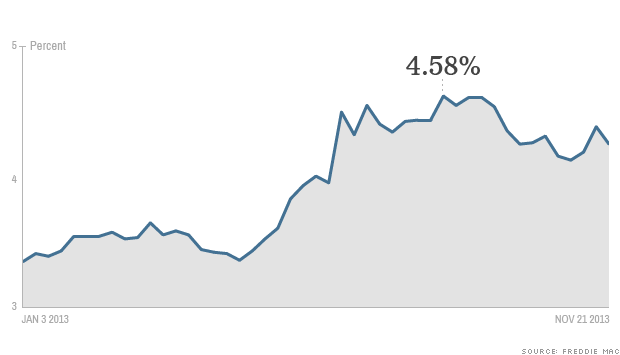
Average rates on 30-year fixed mortgages fell to 4.22% this week, down from a 2013 high of 4.58% in August.
NEW YORK (CNNMoney)

Mortgage rates fell significantly this week amid weaker-than-expected economic reports, according to a weekly survey by Freddie Mac.

30 year mortgage ratesThe average rate for a 30-year, fixed-rate loan, the most popular mortgage product, fell to 4.22% from 4.35% last week, Freddie Mac reported. Meanwhile, average rates on 15-year, fixed-rate loans, typically used for refinancing higher interest mortgages, dropped to 3.27% from 3.35% the week before.
This week's drop was one of the steepest during a year of mostly rising rates. The 30-year started 2013 at 3.34% and reached a high of 4.58% in August.
Related: American Dream homes: What you'll pay in 10 cities[1]
Frank Nothaft, Freddie's chief economist said fixed mortgage rates fell amid reports of weaker manufacturing growth, with industrial production declining by 0.1% in October, below expectations. He also cited declines in the overall inflation rate, noting that the consumer price index saw its "smallest increase since October 2009" last month.
Is there a housing bubble in California?  [2]
Is there a housing bubble in California?
Weighing on mortgage rates long-term is the Fed's stimulus program -- known as quantitative easing -- which entails that it buy $85 billion in bonds each month. The impending appointment of Janet Yellen as Fed chairman[3], who has defended the QE3 policy, has many believing the Fed's policy will remain in place.
Related: Five of the most (and least) affordable housing markets[4]
"Ms. Yellen would likely continue the QE policies started under Chairman Bernanke until there was very clear evidence that the economy would thrive, not just endure, without them," said Keith Gumbinger, a spokesman for HSH.com, a mortgage information company.
Find Homes for Sale…Check Out www.pearlandhomesforsale.biz.  Your Home Resource for Pearland and surrounding areas

Source : http://rss.cnn.com/~r/rss/money_realestate/~3/BsqpbQr8B0w/index.html
Average rates on 30-year fixed mortgages fell to 4.22% this week, down from a 2013 high of 4.58% in August.
NEW YORK (CNNMoney)

Mortgage rates fell significantly this week amid weaker-than-expected economic reports, according to a weekly survey by Freddie Mac.

The average rate for a 30-year, fixed-rate loan, the most popular mortgage product, fell to 4.22% from 4.35% last week, Freddie Mac reported. Meanwhile, average rates on 15-year, fixed-rate loans, typically used for refinancing higher interest mortgages, dropped to 3.27% from 3.35% the week before.
This week's drop was one of the steepest during a year of mostly rising rates. The 30-year started 2013 at 3.34% and reached a high of 4.58% in August.
Related: American Dream homes: What you'll pay in 10 cities[1]
Frank Nothaft, Freddie's chief economist said fixed mortgage rates fell amid reports of weaker manufacturing growth, with industrial production declining by 0.1% in October, below expectations. He also cited declines in the overall inflation rate, noting that the consumer price index saw its "smallest increase since October 2009" last month.
Is there a housing bubble in California?
Weighing on mortgage rates long-term is the Fed's stimulus program -- known as quantitative easing -- which entails that it buy $85 billion in bonds each month. The impending appointment of Janet Yellen as Fed chairman[3], who has defended the QE3 policy, has many believing the Fed's policy will remain in place.
Related: Five of the most (and least) affordable housing markets[4]
"Ms. Yellen would likely continue the QE policies started under Chairman Bernanke until there was very clear evidence that the economy would thrive, not just endure, without them," said Keith Gumbinger, a spokesman for HSH.com, a mortgage information company.
Find Homes for Sale…Check Out www.pearlandhomesforsale.biz.  Your Home Resource for Pearland and surrounding areas

Source : http://rss.cnn.com/~r/rss/money_realestate/~3/BsqpbQr8B0w/index.html

Wednesday, November 20, 2013

DePelchin's Children's Center Holiday Project in Need


The holidays are fast approaching! We invite you to make a dream come true for a child this year by participating in the annual DePelchin Children's Center Holiday Project.

This annual effort provides gifts and basic needs to the children and families utilizing DePelchin Children's Center services. During this time, local businesses, organizations and individuals sponsor children by fulfilling wish lists, hosting toy drives, donating needed items, making monetary contributions or volunteering to sort and pack gifts. With the support of the community, we are able to brighten the holidays for over a thousand children each season! 

Here are four ways you can make a dream come true for DePelchin's children: 

Sponsor a Child

     Click here to view and select wish lists

Make a Cash Donation

Click here to make a cash donation

Host a Toy Drive

Click here for more information.

Volunteer Your Time

Click here to learn more.


For more information, please contact our Holiday Project coordinator at 713-802-7724 or email holidayproject@depelchin.org.


Tuesday, November 19, 2013

Alexander Middle School held a Veterans Day “Support Our Troops”

Alexander Middle School holds Veterans Day coloring contest
Alexander Middle School held a Veterans Day “Support Our Troops” coloring contest, with winners announced Nov. 8. Pictured (from left) are teacher Katherine Nemeth, first-place winner Catherine Llope, third-place winner Destiny Roman, second-place winner Heaven Henry and assistant principal Teresa Foster


courtesy Pearland ISD
.

Turn SunnyD Labels into Books for Teachers


Did you know that the average teacher spends almost $400 on classroom materials every year? And with budgets getting cut across the country, parents and teachers are having to work even harder today to ensure that they achieve the best possible education for their children. That's why SunnyD is proud to support the efforts of teachers and parents with the SunnyD Book Spree. The program is simple. Parents collect labels and send them into the classroom with their kids. Teachers then send the labels into SunnyD to get free books. 20 labels earns your class 20 free books. It's the perfect way to bring the power of reading into your kids' classroom.


For details and a list of eligible products please visit the SunnyD website. http://sunnyd.com/bookspree/index.html


Pearland FFA WIN Sweepstakes and Advance

Pearland FFA wins district sweepstakesPearland FFA students won the district sweepstakes at the District VI Leadership Development Events Contest Nov. 12. Competing against 29 other area high schools, seven of 13 Pearland FFA teams qualified to advance to the area contest on Nov. 23.

Advancing teams include:

Agricultural advocacy (first place)

Agricultural issues (first place)

Job interview (first place)

Senior skills (second place)

Junior chapter conducting (second place)

Junior creed (second place)

Junior skills (second place)

LDE team and individual contests give FFA students an opportunity to demonstrate public speaking, decision making, communication and knowledge of agriculture and the FFA organization. Students advance through district and area rounds before competing at state

Education foundation board in place


After an operational meeting Oct. 23, the Pearland ISD Education Foundation is hitting the ground running with a board of directors.

Elected executive committee officers, who will serve one-year terms, include. . . .

Jeff Barry, President
Lisa Brown, Vice President of Development
Kyle Ford, Vice President of Administration
Donna Rizzo, Treasurer
Dr. John Kelly, Secretary (permanent position)
Andrew Solomon, Board of Trustees Representative

Through the board's vision and direction, the foundation will provide financial support to Pearland ISD, its teachers and classrooms through fundraising for programs and projects that may fall outside the district's general operating budget.

Moving forward, the 30-member board will review sample grant applications, general fund management policies and marketing during its next meeting. In addition, the board will discuss a founders' drive and solicitation of lead gifts.

As board members manage the foundation, they will also set funding priorities.

Ideas already on the table include teacher-initiated instruction projects, staff development, scholarships, student/teacher recognition programs and/or endowment funds.

How to Support the Foundation

The Pearland ISD Education Foundation will provide additional support to the district's 20,000 students and 1,200 teachers.

As a 501(c)(3) organization, the foundation will allow companies, organizations and individuals to receive the maximum tax credit for their donations and support of the district.

All donations are tax-deductible. To donate to the foundation, contact Pearland ISD business/community liaison Moniki Specks Mason at specksm@pearlandisd.org or 281.485.3203.

(11/4/2013)

Students commit to healthy choices


Healthy living took front and center in Pearland ISD schools this October. For the H-E-B Challenge, Carleston Elementary students and staff exercise after school.  Activities throughout the month focused on health and safety in daily lives.

Red Ribbon Week (Oct. 28 - Nov. 1)

During this week celebrating being drug-free, students participated in fun activities and presentations emphasizing the importance of healthy lives minus drugs.  Activities ranged from drug-free door-decorating contests and themed dress days (e.g., crazy sock day -- "sock it to drugs") to Pearland Police Department and Houston Texans Toro mascot presentations.

Healthy at H-E-B Community Challenge (Sept. 1 - Oct. 31)

Pearland ISD schools took on the challenge of proving that Pearland is one of the healthiest communities in Texas.

Although challenge results are still pending, the City of Pearland surpassed its goal of 250,000 points community-wide.

Throughout the eight-week challenge presented by "It's Time Texas," students and teachers showed their competitive spirit by participating in themed fruit and veggie weeks, breaking a sweat in fitness classes during and after school and signing personal wellness pledges.

Students learned that being healthy involves making the right choices in small decisions throughout the day.

Fire Prevention Month (October)

The Pearland Fire Department visited elementary schools district-wide throughout the month to teach students how to protect themselves during fires, such as the "stop, drop and roll" technique.

Students saw firefighting equipment and a fire engine up close to learn about the firefighter's role in helping to protect those in danger.

(11/4/2013)